
UV/Vis Multiple ATR spectrometer

SIS-5100 / S-SPR6100 series Optical Waveguide spectroscopy!
- Optical Waveguide / high sensitvity for trace samples.
- Spectrometry / characteristic to use evansescent waves.
- has / possibility to collaborate with other methods.
Flyer

Application notes
- Principle of Optical Waveguide Spectroscopy
- High-sensitivity measurement of LB FILM
- Simultaneous measurement by electrochemical measurement and waveguide spectrum measurement
- Real-time measurement of molecular orientation using linear polarized light
- Analysis of dye aggregation state, solar cell, organic EL dye film
- Spectral measurement of organic crystals, powders and solids
- Metabolism and functional analysis of biomolecules and microorganisms
- Basic research on biosensing, SPR, sensor using gold nanoparticles
- Bandgap measurement of inorganic thin films and nanostructures
Image of optical waveguide spectrometry
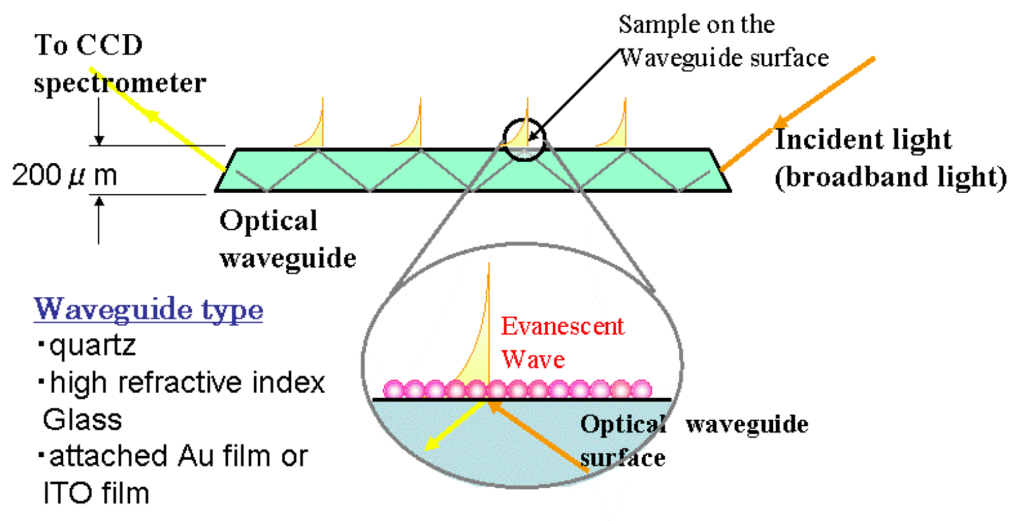
The SIS-5100 Surface and Interface Measurement spectrometer has been developed on the basis Optical Wave Guide Spectroscopy technology. The SIS-5100 utilizes evanescent waves with repeated reflection which allows the system to measure the spectral absorption spectrum of ultra-thin films and weak absorption films with high sensitivity while it was difficult to measure them with conventional UV/Vis spectrometers.
Thin films (samples) used for organic EL and organic thin-film solar cells are generally as thin as several tens of nm to several hundreds of nm, so absorption is very small depending on the measurement wavelength, and it is too small for the conventional spectrophotometers to detect. In many cases, it was difficult to measure because it could not be detected.
Therefore, with general spectrophotometers, it was necessary to make adjustments on the sample, such as increasing absorption by increasing the thickness of the sample so that it could be measured. However, increasing the thickness make the thickness of the sample different from the thickness of the sample actually used. Since the properties of the sample may differ from those in the thin state, there is high possibility that the accurate measurement cannot be obtained.
For the SIS-5100, which utilize Optical Waveguide Spectroscopy is capable of measuring the absorption spectrum with the thin film sample (without any thickness adjustment) placed on the dedicated optical waveguide. In principle, when white light is incident on a quartz optical waveguide (plate) from one side, repeated reflection occurs and evanescent wave is generated. High-sensitivity measurement is possible by detecting the evanescent wave.
Since the thickness direction of the sample is very thin, it is explained that the absorption measurement is performed using the lateral direction (distance) of the sample.
In addition, since the SIS-5100 can measure the spectral absorption spectrum in real time using a multi-channel spectrometer, it is also possible to evaluate changes in the spectral absorption spectrum of electrochemical.
For example, if electricity is applied at a certain timing, it is possible to check in real time how the spectral absorption spectrum changes from that without electricity. With conventional spectrophotometers, the amount of light absorption of thin films is very small, so even if measured in real time, the amount of change is too small to detect changes after electricity was applied. While with the SIS-5100, such evaluation is possible with high sensitivity.
Also, now applying electricity was just explained in the above, it is also possible to measure changes in the same way by adding a liquid instead of electricity. The spectral absorption spectrum can be performed in real time, adding a reagent at a certain timing, and then the subsequent change can be observed in the spectral absorption spectrum. This applications must be demanded in bio-related (biological-related) field.
Of course, it is possible to irradiate the light to the sample at a certain timing and then the change in spectral absorption spectrum can be measured as well.
The feature of SIS-5100 is that ultra-thin films and weak absorption films with very low light absorption can be measured with high sensitivity using evanescent waves.
In particular, for the samples for which it is difficult to change the film thickness (materials cannot be thickened or if the film thickness is thickened, the property of the sample may change) and samples for which the film thickness cannot be increased (such as biological membranes whose thickness cannot be controlled by humans.), the performance of SIS-5100 can be utilized at best. The SIS-5100 can be differentiated from general spectrometers.
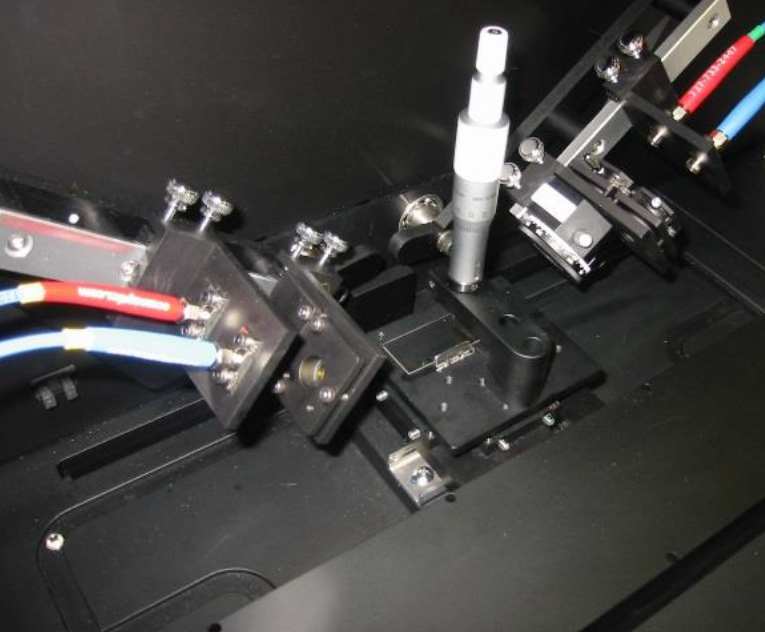
Sample room for analysis
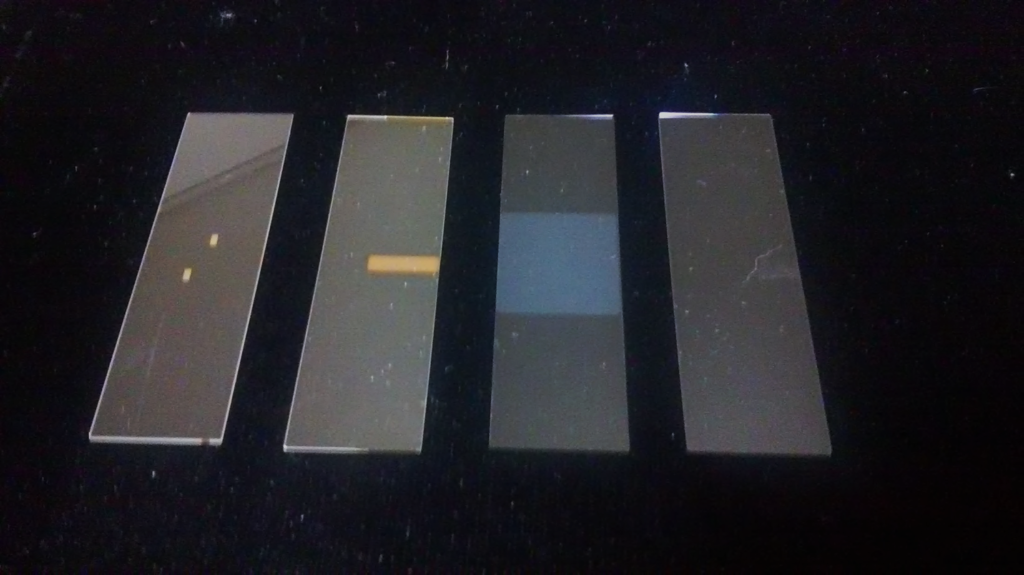
Optical waveguide variation
Applications
- Reak-time analysis, Surface and Interfacial analysis
- Nano Technology for Organic Devises
- Molecular domain structure analysis of Organic Electro Luminescense
- Dye-Sensitaized Solar Cell
- Photo-functionak analysis of molecular on photo-irradiation,Photo deplete
- Micro Biology for sensor and function analysis
- Affinity of bio molecular by Spectroscopic Surface Plasmon Resonance(SSPR)
- Collaborate with Electrochemistry
- Infomation of molecular orientation with Polarized Optical Waveguide Spectroscopy
Specification
The main system
| Incident angle adjustment | normal to surface 90~35degrees(fine adjustment below 0.005) |
| Out put angle adjustment | normal to surface 90~35degrees(fine adjustment below 0.005) |
| Y scan adjustment | 0~20mm(fine adjustment below 0.005) |
| Light source | Xe 150W |
| Dimension | W620×D550×H330mm |
Indiction choose normal to surface angle or parallel to surface angle
Computer
Windows 10 Base 64bit
Original application software for absorption spectra and SPR spectra and save on time
Power
100~110V AC 0.6KVA(world wide)
Spectrometer
| Wavelength | 220~700nm or 400~1000nm |
| CCD | 3048pixel |
| Resolution | 1.25nm |
Optical wave-guide type
| Dimension | t0.2×L65×W20mm each side has 60 degrees tilt angle. |
| Quartz or high reflective index glass | attached Au, attached ITO |
Options
