
Basic research on biosensing, SPR, sensors using gold nanoparticles

In the optical waveguide method, an SPR sensor can be constructed by attaching a precious metal thin film such as Au or Ag to the waveguide. By attaching SAM on a gold thin film and fixing the antibody, it becomes a biosensor using the SPR method. The intermolecular interactions of non-absorbed samples can be observed.
As the waveguide, a high refractive index glass waveguide with Au spotted is used. Au spot shape for bath measurement is different from that for flow path measurement. After attaching SAM of carboxyundecanethiol to the Au surface, fix the mouse IgG antibody and set the PDMS flow path as shown in the figure. (Fig.13)
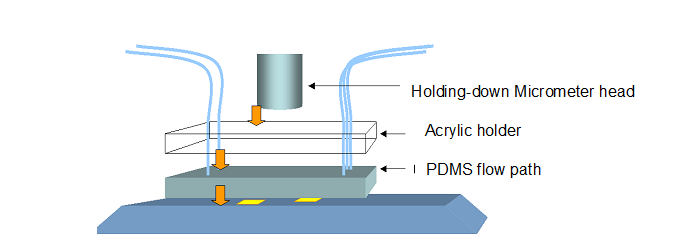
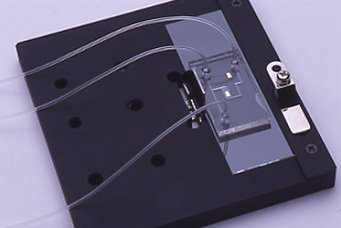
Fig13.The flow path was fixed to a waveguide with Au spots.
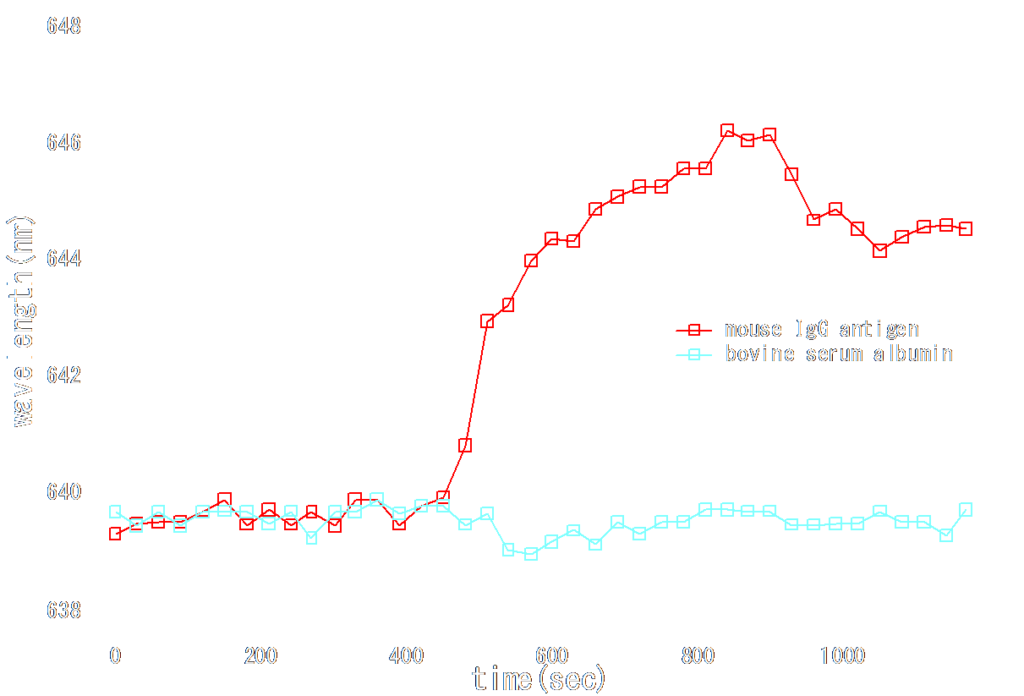
Fig14. It responds to the flow of mouse IgG antigen, but not to bovine serum albumin.
There is no response when bovine serum albumin is flowed(blue), but interaction-based shifts are obtained when mouse IgG antigens are flowed. (Fig.14)
70. “Immobilization of gold nanoparticles on optical waveguides with organosilane monolayer” Takuya Nakanishi, Harumi Takada, Hironori Iida, Mayuki Kajiura and Tetsuya Osaka, J. Colloids and Surfaces A, 313-314, 234 (2008).
71. “Broadband Plasmon Waveguide Resonance Spectroscopy for Probing Biological Thin Films” Han Zhang, Kristina Orosz, Hiromi Takahashi, S. Scott Saavedra, Appl. Spectrosc., 63, 9, 1062 (2009).
72. “Biosensing by optical waveguide spectroscopy based on localized surface plasmon resonance of gold nanoparticles used as a probe or as a label” Mayuki Kajiura, Takuya Nakanishi, Hironori Iida, Harumi Takada and Tetsuya Osaka, J. Colloid Interface Sci., 335, 1, 140 (2009).
73. “SPR Sensing of Bisphenol A Using Molecularly Imprinted Nanoparticles Immobilized on Slab Optical Waveguide with Consecutive Parallel Au and Ag Deposition Bands Coexistent with Bisphenol A-Immobilized Au Nanoparticles” Yuki Taniguchi, Eri Takano and Toshifumi Takeuchi, Langmuir, 28-17, 7083 (2012).